Surveying, engineering, construction layout, and consulting from one integrated team. If you need something that isn't listed, give us a call and we'll work with you to make sure your needs are met.
Land surveying in Indiana is regulated by the Board of Registration for Professional Land Surveyors under Title 865 IAC, which defines a specific process for surveyors to follow. Every survey begins with research and evaluation of recorded documents. Our surveyors then go to the site and look for evidence on the ground.
All surveys are based on the evidence found in the field and in historical records. We gather and evaluate that evidence to locate the property boundaries, taking into account local, state, and federal law and court precedent. Sometimes extrinsic evidence and testimony are needed to find the true location of a boundary line, and boundary lines can differ from title lines because of unwritten title rights such as adverse possession, acquiescence, and estoppel.
The final survey includes a plat and a surveyor's report. The plat shows everything required by surveying codes and law and by the type of survey you ordered. The report explains the results and the reasoning behind the property's location, giving our professional opinion of the evidence and how it was weighed against the law and court precedent.

RMA provides professional civil engineering at every stage of development, and we keep our clients involved throughout so every project has a personal touch.

Full-service site development spanning the surveying, engineering, and construction phases. Successful site design integrates every technical discipline, and we work to achieve everything our client envisions.
A robust transportation network is essential for every community. RMA has served town, city, county, and state governments for decades, and our clients benefit from that institutional knowledge, from highway design to intersection efficiency.
Local utilities are as vital to everyday life as roads, and the country is falling behind on upgrades and upkeep. RMA designs a wide range of water-related utility systems, and our experience allows a quick turnaround.
"Water infrastructure in the United States is clearly aging, and investment is not able to keep up with the need." American Society of Civil Engineers
RMA handles construction layout at every stage of a project, from verifying initial control points through completion. Knowing the standards and procedures for construction layout improves the quality, productivity, and profitability of the whole job. We work closely with the prime contractor, the design engineer, and the architect, and keep communication open so the project keeps moving.
Our project engineers take the design engineer's plans and build staking layouts for our field crews, who place the wooden stakes and hubs used to lay out curbs, pavement, sidewalks, and structures. A stake misplaced by even one foot can mean thousands of dollars in reconstruction, so we slow down and make sure every stake matches the plans exactly.

State and federal regulations can be hard for municipalities to navigate. Water and environmental rules grow every year, and the penalties are steep. RMA gives professional, expert guidance to get through the regulations and the government red tape, working with cities, towns, and counties (LPAs) on all kinds of infrastructure projects.
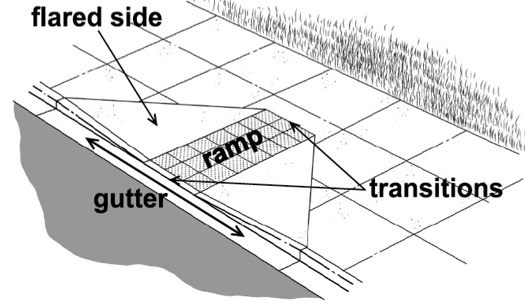
One of our main specialties is ADA compliance. Sidewalk ramps are regulated, and municipalities have limited time to bring their intersections into compliance. RMA has worked with Wabash, Marion, Peru, and many other Indiana communities to get there.

Has your community completed an ADA self-evaluation and inventory of its sidewalks, crosswalks, and curb ramps? Do you have a Transition Plan to remove the barriers it found, with a probable cost and schedule?
The Americans with Disabilities Act of 1990 gives people with disabilities civil rights protections like those based on race, sex, national origin, and religion, guaranteeing equal opportunity in employment, public accommodations, transportation, state and local government services, and telecommunications.
INDOT has finalized Indiana's standard crosswalk ramps to meet ADA requirements, and upgrades are under construction across the state. INDOT and the FHWA Indiana Division are directing every Local Public Agency (LPA) without a current ADA inventory or Transition Plan to complete one. INDOT covers the crosswalks and curb ramps on all corners directly next to any state road, including those running parallel to it.
A Transition Plan lays out how to remove the barriers found in an LPA's self-evaluation and inventory, with a probable cost estimate and schedule. Federal-aid recipients have been required to complete self-evaluations since 1973 under Section 504 of the Rehabilitation Act, and under the ADA and Section 504 every government with 50 or more employees should have finished a Transition Plan by 1992. If your community receives federal funds, you need a self-evaluation of your public facilities and right-of-way, plus a Transition Plan if you have 50 or more employees.
It covers the self-evaluation, the inventory, and the Transition Plan. Contact our Marion office to learn more.
Tell us about the property or project and we'll point you the right way.